|
In addition to the standard cash and non-cash payment methods that are displayed at the cash register, Dotypos also includes so-called hidden payment methods. These will not be visible to the cashier. These are, for example, payment methods Foodora, Bolt, Bolt for ordering services or Qerko, where the order from these services is automatically "paid" by the cash register with the corresponding hidden payment method after closing. You can find the order paid in this way in the history or in the sales report. |

Changing the order of payment methods
Quick pay and quick action buttons
Create the same payment method with different settings
Restricting payment methods using rules
Write-offs of products and raw materials
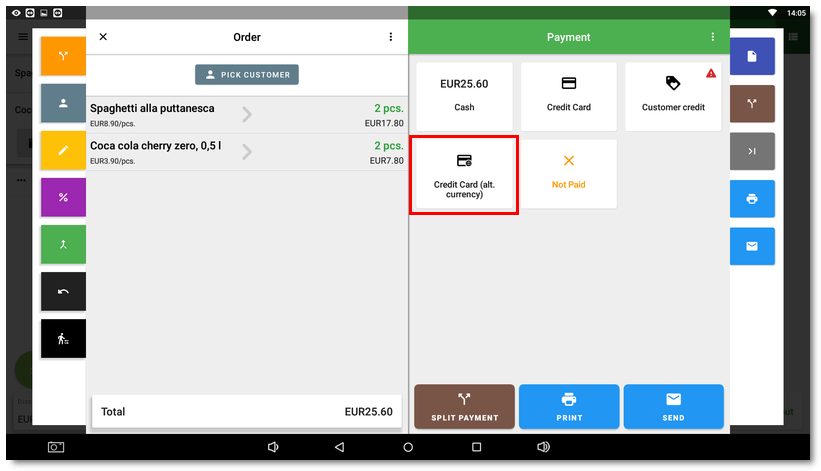
Card payment in an alternative (foreign) currency
Payment methods
Payment methods
List of active payment methods. Tap the key icon 
 to open the settings of the payment method. Tap the trash icon
 to remove it from the list. Tap the + ADD PAYMENT METHOD button to add another payment method to the list and set its behavior, see the table below the images.

|
You can add your own banknotes and coins to each cash payment method by clicking on the key icon |

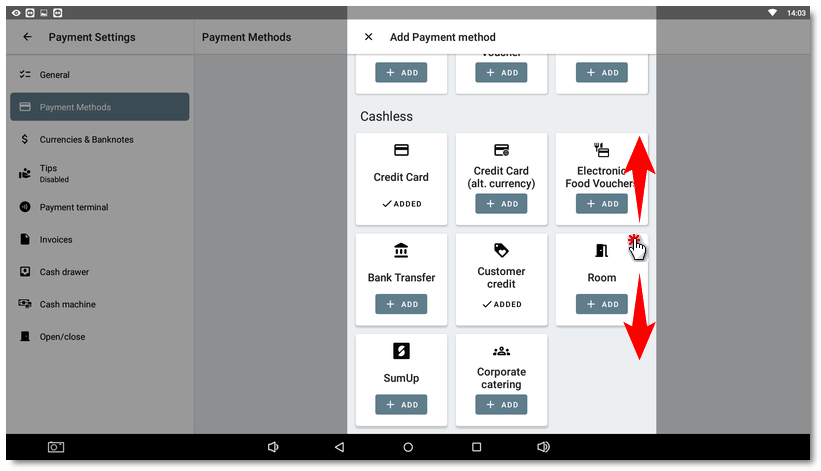
The payment methods that can be added are divided by type. You scroll through them by simply scrolling the screen down and up, i.e. using the scroll gesture. In addition to the standard payment methods, you can also add cash in another currency, such as dollars, payments for ordering or delivery services or Write-off.
|
For transfer payments, you can activate the printing of a QR code with the payment details on the receipt in the printable data in the Print receipts print job (option Print QR payment code on transfer receipts). By scanning the QR code via their mobile phone and banking, the customer then makes the payment. However, you should always verify that the payment has actually arrived in your account. |
Visibility |
The payment method can be hidden at the cash register or in the Mobile Waiter with this setting. The operator will then not be able to use it. |
Exchange rate |
Use the EDIT button to enter the exchange rate for the additional currency, according to which the cash register will convert the amount to be refunded into your home currency. This is suitable if you have the option Return in CZK to foreign currency payments active in the General section. |
Paid, To return |
If you have the Use Paid, To return option active in the General section for cash payments, you can set the behaviour for a specific payment method here to override the general settings. Requiring the customer to enter the amount received can optionally be enforced at the cash register or Mobile Waiter. |
Banknotes |
A menu of banknotes and coins to enter the amount received from the customer. Use the EDIT button to open the menu for editing. Custom note and coin values can be added to the menu, or long hold on an already entered note or coin to remove it from the menu. Press the RESET button to restore the original default menu. Suitable if you have activated the option Use banknotes to enter paid value. |
Connected |
Only for the Credit card payment method. Activates communication with a supported payment terminal connected via the payment terminal driver. Temporarily deactivate this option in case of connection problems. The cash register registers the card payment without the terminal. Then enter the amount to be paid manually on the terminal. |
Cash drawer |
Determine whether the cash drawer should be opened when paying with a given payment method. |
Determines whether an order paid with this payment method will be fiscalized within EET 2.0 or not. |
|
Allow split payment
Hides the split payment button in the payment dialog. However, the split payment itself will still be possible unless the full amount is entered for payment.
Allow issuing an unpaid document
An additional payment method, Not paid, is added to the payment dialog. Select it to mark the order as unpaid. The transaction will be marked as unpaid in the History and you will be notified of this unpaid order when you close the cash register. If this option is enabled, you will also be able to mark the order as unpaid when you cancel. Additional payment is possible in History using the Order options menu.
Reorder payment methods
Tapping this option will display the buttons for each payment method as they appear in the payment dialog. You can edit their order here by dragging and dropping.

|
You can define your own banknotes in the Electronic Food Vouchers payment method settings, according to the value of the meal vouchers you receive. These can then be displayed when entering the amount to be refunded in the payment dialog or in the Stocktake report. |
Configure quick payment buttons
You can add selected actions and payment methods to the bottom panel of the main screen. These options will then make certain operations on the cash register faster. For example, if you add the Cash and Credit card payment methods, you can skip the Payment dialog and tap the button with the selected payment method to pay and close the order directly. That is, provided that you do not use tips or records of cash received.
Use the action buttons to add quick actions to the left side or payment methods to the right side. Use the buttons to remove actions / methods from the panel. Use the buttons  to toggle between the icon and the text icon.

Creating the same payment method with different settings
You can create multiple identical payment methods, but with different configurations. For example, you set up the Cash payment method differently for cash registers and differently for mobile waiters. Or when paying by card, you call the payment terminal with one method and not the other. So there will be two Cash payment methods, one displayed only on cash registers and the other on mobile waiters with different settings.

Write-off of products and raw materials
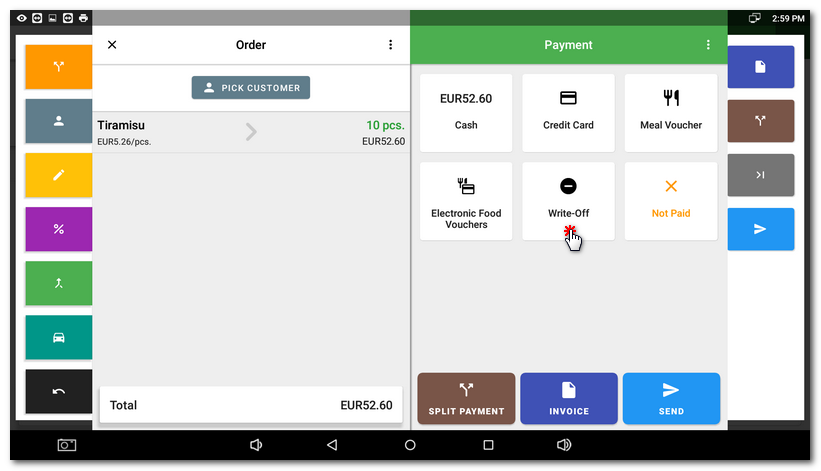
If you are using Ingredients, Dotypos also offers raw material write-off. Write-off is a standard payment method in Dotypos. By adding this method, you can easily deduct items from stock (e.g. when you spill a drink) directly from the payment dialog. When you issue a receipt using the Write-off payment method, all products sold, including their raw materials, are deducted. However, a proper receipt will not be issued, but only a confirmation of the deduction made, which will not affect the sales and VAT of the cash register in any way. When the order is closed using the Write-off method, the movement in the warehouse will be correctly recorded.
How to write off products and their raw materials?
It is very simple:
1.In the Application Settings, activate the Write-off payment method in the Payment Settings section.
2.You will then find this payment method in the payment dialog.
3.Bill the products you need to write off as usual and "pay" the order using the Write-off payment method.
4.If you add a note (e.g. the reason for the write-off) to the order paid in this way, it will be written into all products - raw materials - that are being written off.
5.The products will be written off including their raw materials (ingredients).
|
You can find the value of the written-off products in the cash register in the Sales Overview, and in the Dotypos cloud in the sales reports. An alternative option is to first park the products for write-off on a specific table on the table map and then perform a bulk "payment" using the Write-off method. You will then find all the written-off goods under that table. |
Card payment in an alternative (foreign) currency
If you use a Dotypay terminal with the Multitid or Multicurrency feature active for payment transactions in different currencies, use the special card payment method for an alternative currency in Dotypos. This payment method ensures that the payment in a supported foreign currency is transferred to the connected Dotypay payment terminal:
1.Add the foreign currency / currencies supported by your Dotypay terminal to the cash register.
2.Add the payment method Credit Card (alt. currency) to the cash register.
3.When closing the order, select this payment method in the payment dialog and, if there are more foreign currencies in the cash register, choose the specific currency for the payment (if there is only one foreign currency in the cash register, the payment will be made directly in this currency).
4.The amount in the foreign currency is transferred to the payment terminal, where the customer completes the payment.
5.The order is then recorded in the cash register History including the conversion of the paid amount to the foreign currency used.